
CAT Alignment
The alignment came last.
We began with what a musical loudspeaker should do.
A voice should appear whole, intimate, and startlingly present.
The image should lock into place while the recorded space extends beyond the cabinets.
Bass should be quick, textured, and deep enough to give music real body.
The speaker should preserve touch, tension, and scale without turning every recording into a demonstration.
And the enclosure should occupy far less of the room than the sound it creates.
Only then did we decide how to build it.
We did not begin with a woofer, tweeter, and crossover and ask them to approximate those qualities. We began with the qualities—and developed an alignment around them.
CAT Alignment—Coherent Ambience Topology—is the result.
- One wideband voice through the musical center
- Point-source focus without a head-sized presentation
- Expansive soundstage without sacrificing image focus
- Fast, textured bass with real acoustic reach
- Expansive sound from intentionally compact enclosures
The performer stays put. The space keeps going.
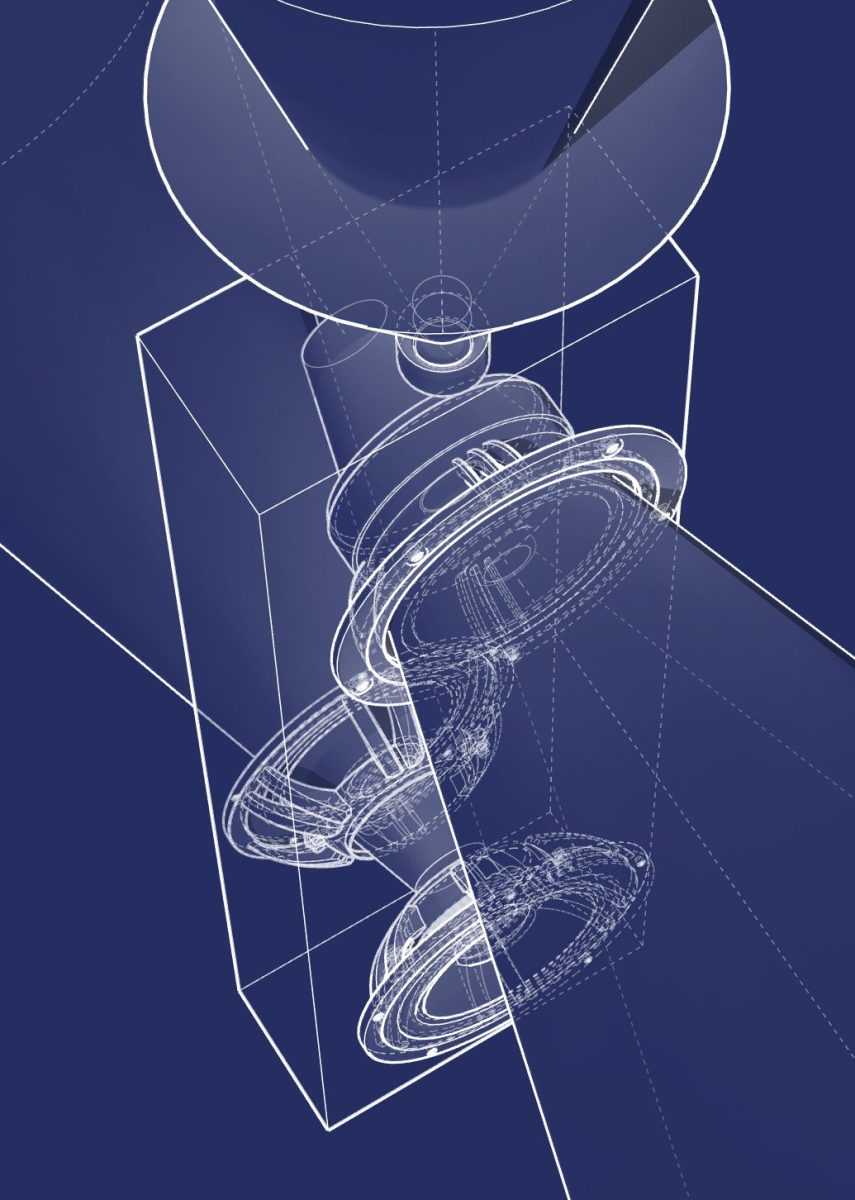
A modern wideband driver can reproduce nearly the entire musical spectrum from one remarkably light, responsive source. There is no crossover dividing the voice. No spatially separated drivers reconstructing the center. Voices and instruments arrive with the continuity, immediacy, and pinpoint image lock that make exceptional full-range loudspeakers so compelling.
That coherence has traditionally come with a cost.
As a wideband driver climbs in frequency, its radiation narrows. The image can be precise, but the sweet spot becomes small and less upper-octave energy reaches the room. Focus remains, while width, height, depth, and ambient scale can diminish.
CAT keeps the focus and restores the space.
The upward-firing AER ambience system enters within the audible upper treble—high enough to remain outside the vocal range and avoid becoming another forward-facing voice. Positioned on the same centerline, directly above the wideband driver’s voice coil, it returns spatial energy to the room without pulling the performer apart.
This is not a supertweeter chasing debatable ultrasonic effects. It contributes audible information where a wideband driver’s dispersion naturally begins to narrow. Its upward orientation greatly reduces the direct interference, lobing, and image pull another front-facing source could introduce.
The wideband driver creates the image. CAT gives that image a room to inhabit.
The result is intimacy without constriction and spaciousness without diffusion. The performer stays precisely placed while the acoustic environment develops naturally around them.
Modern wideband drivers changed the bargain.
These are not your father’s full-range drivers.
The old full-range ideal was beautiful: one driver, one voice, one coherent source.
Its limitations were equally familiar—restricted bass, narrowing treble, uneven tonal balance, limited scale, and enclosures large enough to turn commitment into furniture.
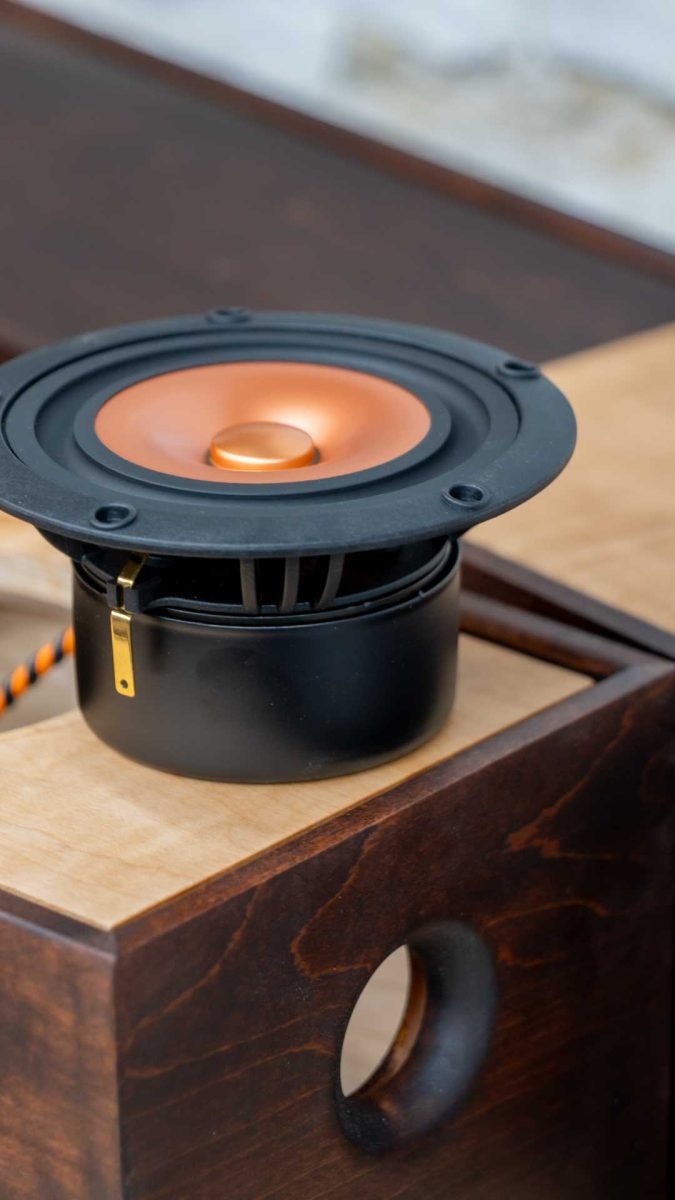
Modern wideband drivers changed what is possible. The Markaudio drivers used in current Panthaerstein loudspeakers combine exceptionally low moving mass with powerful motors, useful excursion, and low-frequency capability that would have been difficult to achieve reliably a generation ago.
This is full-scale musical performance without a full-scale cabinet.
In our current loudspeakers, the wideband driver produces the bass. Momentae’s passive radiators are not hidden woofers, and Sveltae’s tuned vent is not another driven source. Each is an acoustic loading system that helps the same wideband driver reach lower while preserving its speed, texture, and immediacy.
Properly loaded, these drivers reach into the low-40-hertz region—the territory of the low E on bass guitar and double bass. That is real acoustic reach: enough to give most music convincing foundation, pitch, and physical presence from a surprisingly compact enclosure.
We do not pretend they are subwoofers or chase an impressive-looking 20 Hz specification at the expense of everything else. Within sensible limits, they also respond remarkably well to modern equalization when more weight is wanted.
Why isn’t every loudspeaker built this way?
Most advances in driver technology have been used to improve familiar architectures. Panthaerstein used them as permission to reconsider the architecture itself.
Conventional two- and three-way designs are proven, familiar, and highly capable. They provide predictable paths to extreme output, deep bass, and easy-to-compare specifications.
CAT does not claim new physics. Its individual elements have known strengths and known limitations. What is different is their arrangement: one dominant wideband source preserving the performance, audible ambience directed away from the forward image, and bass extension created without another crossover or driven source.
Complexity is added only where it buys something musically valuable—and kept away from the place our hearing is least willing to forgive it.
CAT is not the only way to build an excellent loudspeaker. We believe it is the smartest way to create the coherence, spatial scale, intimacy, tonal body, and physical restraint we want from one.
The full-range ideal remains. The old limitations do not.
For listeners drawn to point-source imaging, crossover-free presence, full-range immediacy, and a soundstage that extends far beyond the loudspeaker itself, CAT is not a compromise between competing ideas.
It is the alignment that finally lets them cooperate.
[Explore the Loudspeakers]